Digital Board for Classroom: Features, Benefits & Smart Board for Teaching Price Explained
Interactive Flat Panels
August,18 2026
Mohammad Hamzah
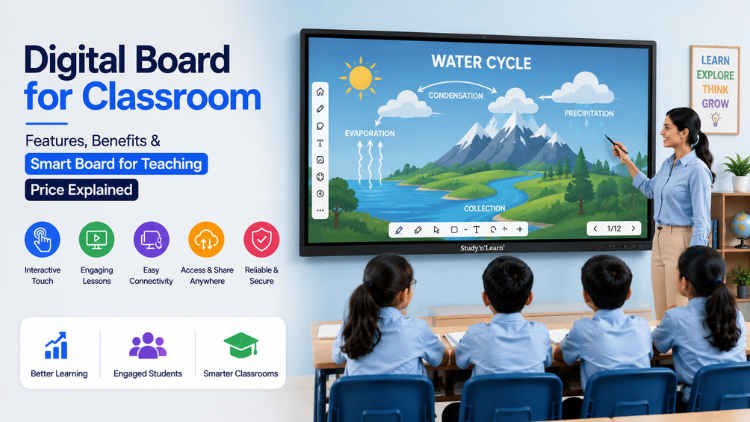
What Is a Digital Board for Classroom?

Key Features Schools Should Look For
Display Resolution and Visual Quality

- 4K resolution for detailed text, diagrams, maps, and videos
- Brightness and contrast suitable for the classroom
- Wide viewing angles
- Accurate color reproduction
- Screen size suited to the room
Touch and Multi-Touch Technology

Operating System and Educational Software

Connectivity and Screen Sharing

Audio and Additional Classroom Features

Benefits of Using Interactive Classroom Displays

- Multimedia lessons using videos, images, simulations, and presentations
- Visual explanation of complex concepts
- Digital annotation and reusable lesson content
- Student participation through touch-based activities
- Classroom collaboration and demonstrations
- Faster access to educational resources
- Reusable teaching materials
- Hybrid learning when supported
What Factors Affect Smart Board for Teaching Price?

- Screen size and display resolution
- Touch technology and responsiveness
- Processor, RAM, and storage
- Operating system and educational software
- Connectivity and audio capabilities
- Installation requirements
- Warranty coverage
- After-sales technical support
- Expected product lifecycle
Features vs Price: What Should Schools Prioritize?

- Classroom requirements: Identify subjects, teaching methods, and usage.
- Display visibility: Match size and brightness to the room.
- Touch performance: Writing accuracy and multi-touch behavior.
- Required software: Confirm compatibility with platforms and files.
- Connectivity: Check wired integration.
- Teacher usability: Ensure controls are easy to learn.
- Warranty and support: Review coverage and service availability.
- Long-term reliability: Consider lifecycle, updates, and total cost of ownership.
Digital Board for Classroom vs Traditional Whiteboard

| Factor | Traditional Whiteboard | Interactive Classroom Display |
| Content | Mostly handwritten | Digital+multimedia |
| Interaction | Manual | Touch-based |
| Videos | Not integrated | Supported |
| Annotation | Physical markers | Digital |
| Content saving | Limited | Digital |
| Screen Sharing | Not available | Supported on compatible systems |
| Collaboration | Basic | More interactive |
| Lesson Reuse | LImited | Easier with digital content |
How Schools Can Choose the Right Solution

- Assess classroom size and seating visibility.
- Identify teaching requirements and common content types.
- Determine the appropriate screen size.
- Compare display quality under actual room lighting.
- Test touch responsiveness with real teaching tasks.
- Review software and file compatibility.
- Check network, port, and screen-sharing requirements.
- Evaluate warranty and technical support.
- Conduct a product demonstration for teachers and IT staff.
- Calculate total cost of ownership before approval.
Common Mistakes to Avoid

- Choosing only by price: Compare complete configurations.
- Buying unnecessary features: Prioritize teaching needs.
- Ignoring classroom size: Ensure readability from the back.
- Overlooking software compatibility: Confirm existing platforms work.
- Skipping product testing: Test touch, annotation, and navigation.
- Ignoring teacher training: Plan staff onboarding.
- Neglecting support: Review warranty and service processes.
- Forgetting future needs: Consider updates and compatibility.
Introducing Studynlearn Interactive Flat Panels

Studynlearn Interactive Flat Panels are among the best options for Indian schools looking for a cost-effective yet high-performance digital teaching solution. These panels are designed to enhance classroom learning with integrated K-12 digital content and advanced AI features.
They offer a 4K UHD display for crystal-clear visuals, supporting interactive and engaging lessons. With multi-touch functionality, multiple students can interact simultaneously, promoting collaboration and active learning. The panels come preloaded with educational content, making them ideal for various subjects.
Additionally, they include a 3-year on-site warranty, ensuring long-term peace of mind for schools. The energy-efficient design further helps in reducing electricity costs, making them a smart investment for schools.
Key Features of Studynlearn Interactive Flat Panels:
- 4K UHD Display: Offers superior clarity for immersive learning.
- Google EDLA: Google EDLA-certified interactive flat panels.
- SNL Board: In-built SNL board with numerous Interactive and AI tools for interactive learning and teaching. Made In-house with a team of 155 members.
- Operating System: Latest Android 16 with an octa-core processor
- Multi-Touch Support: Allows multiple students to interact simultaneously.
- Preloaded Educational Content: Ready-to-use, curriculum-aligned content.
- Camera and Mic: Built-in camera and mic for video conferencing and online classes
- 3-Year On-Site Warranty: Ensures long-term reliability.
- Energy-Efficient Design: Helps reduce electricity costs.
Studynlearn SNL Board

The Studynlearn Interactive Flat Panel comes with an integrated SNL Board, a powerful education-focused platform developed by Studynlearn’s dedicated in-house team of 155+ professionals to make classroom teaching more efficient, engaging, and personalized.
Designed to support the Indian curriculum, the SNL Board provides complete K–12 content, AI courses, 3D models, interactive teaching tools, and rich teacher resources that enhance the learning experience. Teachers can instantly create lesson plans, quickly search topics, generate question papers for classes 1 to 12, and download them in document or PDF format, significantly reducing their workload.
Students benefit from virtual science experiments, real-life educational videos, and practical examples related to their subjects, making complex concepts easier to understand and learning more interactive and effective.
Key Features of Studynlearn SNL Board:
- Curriculum-Focused: Provides step-by-step solutions aligned with the Indian curriculum.
- Multilingual Support: Available in English, Hindi, and various regional languages.
- Fast Content Generation: Creates chapter-wise notes within three days.
- Smart Write: Write content in multiple languages, use text recognition to convert handwritten text into clear and readable digital text, and transform standard text-based equations into properly formatted mathematical formulas.
- K–12 Content: Integrated with comprehensive K–12 educational content.
- Interactives: Practice virtual experiments of Mathematics, Physics, Chemistry, and Biology.
- 3D Models: 3D models for Mathematics, Physics, Chemistry, Biology, and Social Science.
- AI Course: 80+ AI tools, step-by-step learning along with illustrative books.
- Instant Lesson Planning: Enables quick topic searches and question paper generation.
- Vast Resource Library: Offers access to over 6,50,000 questions.
- Custom Content: Allows users to upload PDFs and create personalized study materials.
Conclusion
Frequently Asked Questions (FAQs)
A digital board for classroom is an interactive touchscreen display designed to support modern teaching and learning. It allows teachers to present videos, images, presentations, digital textbooks, websites, and educational applications on a large screen. Teachers can also write, annotate, highlight content, and conduct interactive activities directly on the display. Depending on the model, features may include wireless screen sharing, built-in computing, cloud connectivity, and multi-touch interaction. Unlike a traditional whiteboard, it combines visual presentation with digital interaction, giving educators a flexible platform for delivering lessons and encouraging student participation.
The smart board for teaching price depends on several factors, including screen size, display resolution, touch technology, processing hardware, RAM, storage, operating system, software, connectivity, audio capabilities, warranty, installation, and after-sales support. Advanced models may include additional collaboration, security, or classroom-management features. Schools should avoid comparing products only on their initial purchase price because the overall cost of ownership can include maintenance, software, installation, and technical support. Evaluating features against actual classroom requirements helps institutions identify a solution that provides appropriate performance and long-term educational value.
Schools should evaluate display resolution, brightness, viewing angles, touch responsiveness, multi-touch capabilities, operating system, educational software, wireless screen sharing, connectivity, audio, security, and software update support. A 4K display can provide detailed visuals for presentations, videos, diagrams, and digital learning resources, while responsive touch technology supports annotation and interactive activities. Schools should also consider compatibility with laptops, tablets, cloud platforms, and existing classroom systems. Warranty and technical support are equally important. The ideal solution should combine useful features with reliable performance rather than simply offering the largest specification list.
No. A higher smart board for teaching price does not automatically mean that a product is better suited to every school. More expensive models may offer larger displays, advanced processing, additional software, enhanced connectivity, or premium features, but these capabilities may not be necessary for every classroom. Schools should first identify their teaching requirements, classroom size, student strength, software needs, and budget. Comparing display quality, touch performance, usability, warranty, support, and total cost of ownership provides a more meaningful assessment. The best investment is one that delivers the features teachers and students will actually use.
A digital board for classroom gives teachers a central platform for presenting and interacting with digital learning content. Educators can display presentations, videos, diagrams, websites, digital textbooks, and educational applications while annotating information in real time. Lesson notes can often be saved and reused, reducing the need to recreate certain materials. Teachers can also use interactive quizzes, visual demonstrations, and collaborative activities to encourage participation. These capabilities can make lesson delivery more flexible and support different teaching approaches. However, the educational value depends on teacher training, lesson planning, content quality, and effective classroom implementation.
Schools should create a requirements-based comparison instead of focusing on price alone. Start by identifying classroom size, expected usage, teaching methods, required applications, connectivity needs, and the number of users. Then compare display quality, touch capabilities, processing performance, software, audio, warranty, installation, and technical support. When evaluating smart board for teaching price, schools should also consider total cost of ownership, including maintenance and support over the expected product lifecycle. A moderately priced solution with the right features and dependable support may provide greater value than a more expensive model with capabilities the school rarely uses.
Yes, many modern interactive displays can support hybrid learning when combined with compatible cameras, microphones, conferencing software, and reliable internet connectivity. A digital board for classroom can display remote participants, presentations, online resources, and shared content while teachers annotate information during lessons. Some systems also support cloud-based collaboration and content sharing. However, capabilities vary between products, so schools should verify compatibility with their preferred platforms before purchasing. Hybrid teaching also requires suitable network infrastructure and teacher training. The display should therefore be considered part of a broader digital learning ecosystem rather than a standalone solution.
A digital board combines a large interactive display with digital content and computing capabilities, while a traditional whiteboard primarily provides a surface for writing with markers. With an interactive display, teachers can show videos, presentations, images, websites, digital textbooks, and educational applications without switching between separate teaching tools. Digital annotations can also be saved or shared depending on the system. Traditional whiteboards remain useful for simple writing and low-technology environments, but interactive displays provide greater multimedia and collaboration capabilities. The right choice depends on the school's teaching objectives, infrastructure, budget, and technology strategy.
Before buying, schools should evaluate classroom dimensions, student strength, viewing distance, display quality, touch performance, software compatibility, connectivity, audio, installation requirements, warranty, and technical support. A product demonstration is highly useful because teachers can test common activities such as writing, annotation, screen sharing, opening presentations, playing videos, and accessing educational applications. Schools should also ask about software updates, maintenance procedures, training, and expected product lifecycle. Checking these factors helps decision-makers understand whether the digital board for classroom will fit their existing infrastructure and provide practical value over the long term.
Investing in a smart board for teaching can be worthwhile when the technology addresses genuine classroom needs and is supported by appropriate training and infrastructure. Interactive displays can help teachers deliver multimedia lessons, annotate content, collaborate with students, and access digital learning resources. They can also support hybrid teaching and reusable digital lesson materials when the necessary software and connectivity are available. However, schools should evaluate the smart board for teaching price alongside features, warranty, technical support, maintenance, and expected usage. The strongest value comes from selecting an appropriate solution and integrating it meaningfully into everyday teaching.
