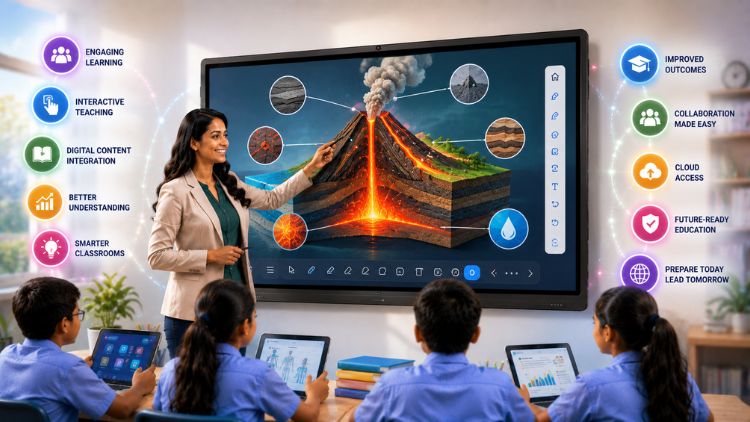
Top Benefits of Using a Smart White Board for Teaching and Learning

Top Benefits of Using a Smart White Board for Teaching and Learning

Interactive Flat Panels  | July,02 2026 | Mohammad Hamzah

Modern classrooms are evolving rapidly. Schools are moving beyond traditional chalkboards and projectors to adopt interactive teaching technologies that improve learning outcomes. One of the most impactful innovations in education technology is the smart white board.
 
Educators today need tools that support interactive learning, digital content integration, collaboration, and efficient classroom management. A smart white board offers all these advantages while helping schools prepare students for a technology-driven future.
 
In this blog, we explore the top benefits of using a smart white board for teaching and learning, explain why schools are investing in this technology, and help educational institutions understand whether the smart board price justifies the long-term value.
 

What Is a Smart White Board?

A smart white board is an interactive digital display that combines the functionality of a traditional whiteboard, computer, touchscreen device, and multimedia presentation system into one platform.
 
Teachers can write, draw, display videos, access educational software, browse the internet, annotate documents, and conduct interactive lessons directly on the screen. Most modern smart boards support multi-touch interaction, wireless screen sharing, cloud integration, and educational applications.
 
In simple terms, a smart white board transforms a classroom from a passive learning environment into an interactive learning experience where students actively participate in lessons.
 
Key Features of Modern Smart White Boards
 
  • Ultra HD touchscreen display
  • Multi-touch writing capability
  • Interactive educational software
  • Screen sharing and collaboration tools
  • Internet access
  • Multimedia content support
  • Digital annotation and recording features

Why Schools Are Investing in Smart White Boards

Schools across the world are investing in classroom technology to improve student engagement, teaching effectiveness, and learning outcomes. A smart white board supports modern teaching methodologies, including blended learning, collaborative learning, project-based learning, and digital education initiatives.
 
Educational institutions also recognize that technology literacy has become an essential skill. By integrating interactive classroom tools, schools prepare students for future academic and professional environments.
 
When evaluating the smart board price, many institutions consider factors beyond the initial purchase cost, including improved classroom efficiency, reduced operational expenses, and enhanced student performance.
 

Benefit 1: Increased Student Engagement and Participation

One of the biggest advantages of using a smart white board is its ability to increase student engagement.
 
Traditional teaching methods often limit student participation to listening and note-taking. In contrast, interactive boards encourage students to actively participate in lessons through touch interaction, quizzes, games, collaborative activities, and multimedia experiences.
 

Practical Classroom Example

Imagine a science teacher explaining the human digestive system. Instead of drawing diagrams on a traditional board, the teacher displays a 3D animated model on the smart white board. Students can interact with the model, identify organs, answer quizzes, and participate in group activities.
 
This interactive approach helps students remain focused and engaged throughout the lesson.
 

Benefits for Student Engagement

  • Higher classroom participation
  • Better attention spans
  • Increased motivation to learn
  • Active learning experiences
  • Greater classroom interaction
Research and classroom experience consistently show that interactive learning environments improve student involvement and academic performance.


Benefit 2: Interactive and Collaborative Learning Experiences

Modern education emphasizes collaboration and teamwork. A smart white board enables students to work together on projects, solve problems collaboratively, and share ideas in real time.
 
Many interactive displays support multiple simultaneous touch points, allowing several students to participate on the screen at once.


Real-World Teaching Scenario

During a mathematics lesson, a teacher divides students into groups and asks them to solve algebraic equations together using the interactive display. Students can simultaneously write, edit, and discuss solutions directly on the board.
 
This collaborative environment encourages:
 
  • Teamwork
  • Critical thinking
  • Communication skills
  • Problem-solving abilities
  • Peer learning
A smart white board transforms students from passive listeners into active contributors.
 

Benefit 3: Improved Teaching Efficiency and Lesson Delivery

Teachers often spend valuable classroom time writing notes, preparing visual aids, or switching between multiple devices. A smart white board simplifies lesson delivery by combining all teaching tools into one platform.
 
Teachers can:
 
  • Prepare lessons in advance
  • Access digital content instantly
  • Save annotations automatically
  • Record lessons for future use
  • Switch between applications seamlessly
  • Share content with students digitally

Practical Example

A history teacher preparing a lesson on World War II can display maps, videos, timelines, historical documents, and interactive quizzes from a single device without changing equipment.
 
This improves lesson flow and allows teachers to focus more on instruction rather than classroom setup.
 
Educational institutions evaluating the smart board price often find that improved teaching efficiency provides significant long-term value.
 

Benefit 4: Enhanced Visual Learning and Knowledge Retention

Visual learning plays a critical role in student comprehension and retention. Research consistently demonstrates that students remember information better when they see, hear, and interact with educational content simultaneously.
 
A smart white board supports visual learning through:
 
  • Interactive diagrams
  • Educational videos
  • Animations
  • Simulations
  • Infographics
  • Digital illustrations

Classroom Example

In a geography class, teachers can use interactive maps, satellite imagery, and animated climate models to explain complex concepts. Students can zoom, annotate, and interact directly with visual content.
 
This multi-sensory approach improves:
 
  • Concept understanding
  • Information retention
  • Memory recall
  • Student confidence
  • Academic performance
The ability of a smart white board to combine visual, auditory, and interactive learning creates a more effective educational experience.
 

Benefit 5: Long-Term Value and Future-Ready Education

Educational technology investments should provide value for many years. A modern smart white board serves as a long-term infrastructure investment that supports evolving teaching methods and educational requirements.
 
Schools benefit from:
 
  • Reduced dependence on paper materials
  • Lower maintenance costs
  • Fewer external teaching devices
  • Digital content integration
  • Remote and hybrid learning support
  • Future software upgrades

Read More: What Is a Smart Board and How Does It Work?

Preparing Students for the Digital Future

Students entering higher education and the workforce require digital literacy skills. By using a smart white board, schools expose students to modern technologies and collaborative digital environments from an early age.
 
This prepares learners for:
 
  • Digital workplaces
  • Higher education environments
  • Technology-based careers
  • Online collaboration platforms
  • Future learning ecosystems
When institutions compare the smart board price with the long-term educational and operational benefits, many find the investment highly cost-effective.
 

Understanding Smart Board Price vs Educational Value

One of the most common questions schools ask is: "Is the smart board price worth the investment?"
 
The answer depends on evaluating educational outcomes rather than focusing only on initial costs.
 

Factors Affecting Smart Board Price

Several factors influence the smart board price, including:
 
  • Display size
  • Resolution quality
  • Touch technology
  • Operating system
  • Built-in software
  • Audio system
  • Connectivity features
  • Warranty and support services

Comparing Cost Vs. Value

Investment Factor Educational Benefit

Initial Hardware Cost

Long-Term Classroom Technology Infrastructure
Interactive Software Improved Student Engagement
Digital Content Integration Better Learning Outcomes
Teacher Productivity Increased Instructional Efficiency
Future Upgrades Long-Term Sustainability
 
Schools that assess the total educational value often conclude that the smart board price represents a strategic investment rather than an expense.
 

Introducing Studynlearn Interactive Flat Panels

Studynlearn Interactive Flat Panels are among the best options for Indian schools looking for a cost-effective yet high-performance digital teaching solution. These panels are designed to enhance classroom learning with integrated K-12 digital content and advanced AI features.

They offer a 4K UHD display for crystal-clear visuals, supporting interactive and engaging lessons. With multi-touch functionality, multiple students can interact simultaneously, promoting collaboration and active learning. The panels come preloaded with educational content, making them ideal for various subjects.

Additionally, they include a 3-year on-site warranty, ensuring long-term peace of mind for schools. The energy-efficient design further helps in reducing electricity costs, making them a smart investment for schools.

Key Features of Studynlearn Interactive Flat Panels:

  • 4K UHD Display: Offers superior clarity for immersive learning.
  • Google EDLA: Google EDLA Certified Interactive Flat Panels.
  • SNL Board: In-built SNL board with numerous Interactive and AI tools for interactive learning and teaching. Made In-house with a team of 155 members.
  • Operating System: Latest Android 16 with Octa-core Processor
  • Multi-Touch Support: Allows multiple students to interact simultaneously.
  • Preloaded Educational Content: Ready-to-use, curriculum-aligned content.
  • Camera and Mic: Built-in camera and mic for video conferencing and online classes
  • 3-Year On-Site Warranty: Ensures long-term reliability.
  • Energy-Efficient Design: Helps reduce electricity costs.

Studynlearn SNL Board 

The Studynlearn Interactive Flat Panel comes with an integrated SNL Board, a powerful education-focused platform developed by Studynlearn’s dedicated in-house team of 155+ professionals to make classroom teaching more efficient, engaging, and personalized.

Designed to support the Indian curriculum, the SNL Board provides complete K–12 content, AI courses, 3D models, interactive teaching tools, and rich teacher resources that enhance the learning experience.

Teachers can instantly create lesson plans, quickly search topics, generate question papers for classes 1 to 12, and download them in a document or PDF format, significantly reducing their workload.

Students benefit from virtual science experiments, real-life educational videos, and practical examples related to their subjects, making complex concepts easier to understand and learning more interactive and effective.

Key Features of Studynlearn SNL Board:

  • Curriculum-Focused: Provides step-by-step solutions aligned with the Indian curriculum.
  • Multilingual Support: Available in English, Hindi, and various regional languages.
  • Fast Content Generation: Creates chapter-wise notes within three days.
  • Smart Write: Write content in multiple languages, use text recognition to convert handwritten text into clear and readable digital text, and transform standard text-based equations into properly formatted mathematical formulas.
  • K–12 Content: Integrated with comprehensive K–12 educational content.
  • Interactives: Practice virtual experiments in Mathematics, Physics, Chemistry, and Biology.
  • 3D Models: 3D models for Mathematics, Physics, Chemistry, Biology, and Social Science.
  • AI Course: 80+ AI tools, step-by-step learning, along with illustrative books.
  • Instant Lesson Planning: Enables quick topic searches and question paper generation.
  • Vast Resource Library: Offers access to over 6,50,000 questions.
  • Custom Content: Allows users to upload PDFs and create personalized study materials.

Conclusion

A smart white board has become much more than a classroom display device. It serves as a powerful educational tool that improves student engagement, encourages collaboration, enhances teaching efficiency, supports visual learning, and prepares students for a digital future.
 
As schools continue adopting technology-driven education models, investing in a smart white board provides both immediate classroom benefits and long-term institutional value.
 
While the smart board price remains an important consideration, educational leaders increasingly recognize that the return on investment extends far beyond hardware costs. Improved learning outcomes, greater teacher efficiency, enhanced student participation, and future-ready education make a smart white board one of the most valuable investments a modern educational institution can make.
 
For More Information, call or WhatsApp us on: 89270-89270.


Frequently Asked Questions (FAQs)

A smart white board is an interactive digital display that combines the functions of a a traditional whiteboard, computer, touchscreen, and presentation system into a single device. Teachers can write, draw, annotate, display videos, access online resources, and interact with educational software directly on the screen. Modern smart boards support multi-touch functionality, wireless screen sharing, cloud integration, and collaborative learning tools. By transforming static lessons into interactive experiences, a smart white board helps educators improve classroom engagement, simplify lesson delivery, and create more effective learning environments.

A smart white board improves teaching and learning by making lessons more interactive, visual, and engaging. Teachers can incorporate multimedia content, live demonstrations, educational applications, and collaborative activities into classroom instruction. Students participate actively through touch interaction, quizzes, group exercises, and visual learning experiences. This increased engagement helps improve concentration, understanding, and knowledge retention. Additionally, teachers can save lesson materials, reuse content, and streamline classroom management, making instruction more efficient while supporting modern educational approaches such as blended learning and collaborative learning.

The primary benefits of using a smart white board include increased student engagement, improved collaboration, enhanced visual learning, better teaching efficiency, and long-term educational value. Interactive displays allow students to participate actively rather than passively consuming information. Teachers can present multimedia content, conduct assessments, and access digital resources instantly. Schools also benefit from reduced dependence on traditional teaching materials and improved support for hybrid and digital learning environments. These advantages make a smart white board an important investment for institutions focused on future-ready education.

Schools are adopting smart white boards because they support modern teaching methodologies and improve educational outcomes. Educational institutions recognize the importance of digital literacy, interactive learning, and technology integration in classrooms. Smart boards help schools create engaging learning environments while supporting collaborative teaching, online education, and personalized learning experiences. They also align with government digital education initiatives and smart classroom programs. As technology becomes central to education, many school administrators view investment in a smart white board as essential for maintaining educational competitiveness and preparing students for future careers.

For most educational institutions, the smart board price is considered a worthwhile investment when evaluated against long-term educational benefits. Although initial costs may vary depending on features and display size, schools often experience improvements in student engagement, teaching efficiency, and classroom productivity. Modern smart boards also reduce dependence on multiple teaching devices and printed materials. When administrators compare the smart board price with improved learning outcomes, technology readiness, and long-term operational value, many conclude that the investment delivers significant returns over time.

Several factors influence the smart board price, including screen size, display resolution, touch technology, operating system, built-in educational software, audio quality, connectivity features, and warranty coverage. Larger displays with advanced features such as AI-powered tools, wireless collaboration, and cloud integration generally cost more. Additional services such as installation, training, and technical support may also affect overall investment costs. Schools should evaluate the total educational value rather than focusing only on purchase price when comparing different smart board solutions available in the market.

A smart white board supports collaborative learning by allowing multiple students to interact with the display simultaneously. Teachers can create group activities, problem-solving exercises, brainstorming sessions, and interactive projects where students actively participate together. Features such as multi-touch capability, wireless screen sharing, and real-time annotation encourage teamwork and communication. Collaborative learning environments help students develop critical thinking, creativity, leadership, and interpersonal skills. By promoting active participation and peer interaction, smart white boards create more engaging and effective classroom experiences.

Yes, a smart white board can significantly improve student engagement and knowledge retention. Interactive lessons that combine visual, auditory, and hands-on learning experiences help students remain focused and actively participate in classroom activities. Educational videos, animations, simulations, quizzes, and collaborative exercises make complex concepts easier to understand and remember. Research and classroom experience consistently demonstrate that students retain information more effectively when they interact directly with educational content. This makes smart white boards valuable tools for improving both learning outcomes and classroom participation.

Yes, a smart white board can be effectively used across all subjects and educational levels. Teachers can utilize interactive displays for mathematics problem-solving, science simulations, language learning activities, geography mapping exercises, historical timelines, arts education, and vocational training. Primary schools benefit from interactive storytelling and visual learning, while secondary and higher education institutions use smart boards for advanced presentations, collaborative projects, and digital assessments. Their flexibility makes them suitable for diverse educational environments and teaching methodologies.

A smart white board helps schools prepare for the future by supporting digital transformation, technology integration, and modern educational practices. Students develop essential digital literacy, collaboration, communication, and problem-solving skills required in higher education and professional environments. Smart boards also support hybrid learning, online education, AI-powered educational tools, and evolving teaching methods. As educational institutions increasingly embrace digital ecosystems, investing in interactive classroom technology enables schools to remain competitive while providing students with the skills needed for future academic and career success.

logo Payment