Why Digital Board Is Essential for the Future of Education
Interactive Flat Panels
July,06 2026
Mohammad Hamzah
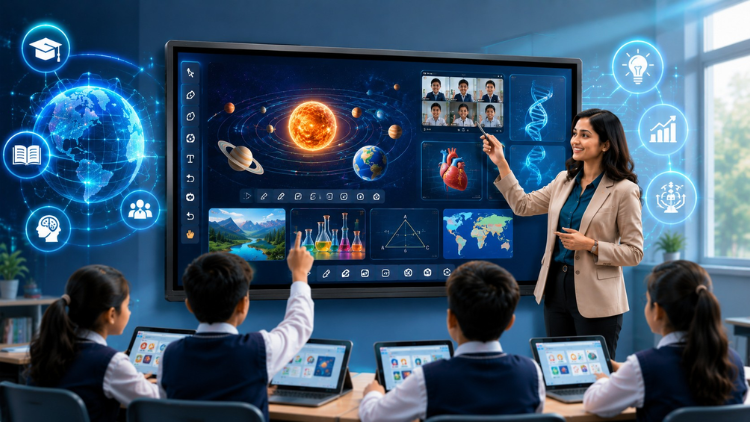
The Evolution of Classroom Technology

What Is a Digital Board and How Does It Work?

- Present multimedia lessons
- Write and annotate content digitally
- Access online educational resources
- Conduct interactive quizzes and assessments
- Display videos, animations, and simulations
- Collaborate with students in real time
- Save and share lesson materials instantly
Why Traditional Teaching Methods Are Evolving

- Diverse student learning styles
- Increased demand for personalized education
- Hybrid and remote learning requirements
- Digital literacy expectations
- Rapid technological advancement
- Greater emphasis on collaboration and creativity
The 5 Key Reasons Why Digital Boards Are Essential for Future Education
Reason 1: Creating Interactive and Engaging Learning Experiences

Reason 2: Supporting Personalized and Adaptive Learning

Reason 3: Enabling Hybrid, Online, and Future-Ready Education

Reason 4: Improving Teaching Efficiency and Educational Outcomes

- Faster lesson preparation
- Reduced administrative workload
- Real-time student assessments
- Improved classroom organization
- Easier content sharing
- Enhanced collaboration opportunities
Reason 5: Preparing Students for a Technology-Driven Future

The Growing Role of Smart White Boards in Modern Education

- Enhance student engagement
- Improve teaching effectiveness
- Support digital transformation initiatives
- Enable collaborative learning
- Facilitate hybrid education
- Increase operational efficiency
- Prepare students for future careers
Challenges Schools May Face Without Digital Transformation

- Lower student engagement levels
- Reduced competitiveness
- Limited hybrid learning capabilities
- Inefficient teaching processes
- Difficulty meeting evolving educational standards
- Reduced digital literacy development
- Limited access to innovative teaching methodologies
The Future of Smart Classrooms and Educational Technology

- AI-powered learning assistants
- Personalized learning analytics
- Augmented and virtual reality experiences
- Interactive educational ecosystems
- Cloud-based collaboration platforms
- Intelligent assessment tools
Introducing Studynlearn Interactive Flat Panels

Studynlearn Interactive Flat Panels are among the best options for Indian schools looking for a cost-effective yet high-performance digital teaching solution. These panels are designed to enhance classroom learning with integrated K-12 digital content and advanced AI features.
They offer a 4K UHD display for crystal-clear visuals, supporting interactive and engaging lessons. With multi-touch functionality, multiple students can interact simultaneously, promoting collaboration and active learning. The panels come preloaded with educational content, making them ideal for various subjects.
Additionally, they include a 3-year on-site warranty, ensuring long-term peace of mind for schools. The energy-efficient design further helps in reducing electricity costs, making them a smart investment for schools.
Key Features of Studynlearn Interactive Flat Panels:
- 4K UHD Display: Offers superior clarity for immersive learning.
- Google EDLA: Google EDLA Certified Interactive Flat Panels.
- SNL Board: In-built SNL board with numerous Interactive and AI tools for interactive learning and teaching. Made In-house with a team of 155 members.
- Operating System: Latest Android 16 with Octa-core Processor
- Multi-Touch Support: Allows multiple students to interact simultaneously.
- Preloaded Educational Content: Ready-to-use, curriculum-aligned content.
- Camera and Mic: Built-in camera and mic for video conferencing and online classes
- 3-Year On-Site Warranty: Ensures long-term reliability.
- Energy-Efficient Design: Helps reduce electricity costs.
Studynlearn SNL Board

The Studynlearn Interactive Flat Panel comes with an integrated SNL Board, a powerful education-focused platform developed by Studynlearn’s dedicated in-house team of 155+ professionals to make classroom teaching more efficient, engaging, and personalized.
Designed to support the Indian curriculum, the SNL Board provides complete K–12 content, AI courses, 3D models, interactive teaching tools, and rich teacher resources that enhance the learning experience.
Teachers can instantly create lesson plans, quickly search topics, generate question papers for classes 1 to 12, and download them in a document or PDF format, significantly reducing their workload.
Students benefit from virtual science experiments, real-life educational videos, and practical examples related to their subjects, making complex concepts easier to understand and learning more interactive and effective.
Key Features of Studynlearn SNL Board:
- Curriculum-Focused: Provides step-by-step solutions aligned with the Indian curriculum.
- Multilingual Support: Available in English, Hindi, and various regional languages.
- Fast Content Generation: Creates chapter-wise notes within three days.
- Smart Write: Write content in multiple languages, use text recognition to convert handwritten text into clear and readable digital text, and transform standard text-based equations into properly formatted mathematical formulas.
- K–12 Content: Integrated with comprehensive K–12 educational content.
- Interactives: Practice virtual experiments in Mathematics, Physics, Chemistry, and Biology.
- 3D Models: 3D models for Mathematics, Physics, Chemistry, Biology, and Social Science.
- AI Course: 80+ AI tools, step-by-step learning, along with illustrative books.
- Instant Lesson Planning: Enables quick topic searches and question paper generation.
- Vast Resource Library: Offers access to over 6,50,000 questions.
- Custom Content: Allows users to upload PDFs and create personalized study materials.
Conclusion
Frequently Asked Questions (FAQs)
A digital board is an interactive display technology used in classrooms to enhance teaching and learning experiences. It combines touchscreen functionality, multimedia content, internet connectivity, annotation tools, and educational software into a single platform. Teachers can present lessons, play educational videos, conduct assessments, and collaborate with students in real time. Unlike traditional whiteboards, a digital board supports interactive learning and personalized instruction. Educational institutions increasingly adopt these solutions because they improve student engagement, simplify classroom management, and help schools create future-ready learning environments.
A digital board is important for the future of education because it supports interactive, personalized, collaborative, and technology-driven learning experiences. Modern students require digital literacy skills and active learning opportunities that traditional teaching methods cannot always provide. A digital board helps educators integrate multimedia content, real-time assessments, hybrid learning, and collaborative activities into daily instruction. As educational institutions continue adopting digital transformation strategies, these technologies enable schools to prepare students for future academic and professional environments while improving teaching effectiveness and overall educational outcomes.
A smart white board improves teaching and learning by creating highly interactive classroom experiences. Teachers can display videos, animations, simulations, presentations, and educational applications while allowing students to actively participate during lessons. This interactive approach increases student engagement, improves knowledge retention, and encourages collaboration. A smart white board also supports visual, auditory, and kinesthetic learning styles, helping educators deliver more personalized instruction. Additionally, teachers can save lesson materials, conduct digital assessments, and share classroom content instantly, making instruction more efficient and effective.
Schools are adopting digital classroom technologies because educational expectations and student learning preferences continue to evolve. Modern classrooms require interactive teaching tools that support collaboration, creativity, and digital literacy development. Technologies such as the digital board and smart white board enable schools to provide engaging lessons, hybrid learning capabilities, and personalized instruction. Educational institutions also benefit from improved operational efficiency, better classroom management, and access to extensive digital learning resources. These advantages help schools remain competitive while preparing students for future educational and career opportunities.
A digital board supports personalized learning by allowing educators to present content in multiple formats that address diverse learning styles and educational needs. Teachers can incorporate videos, animations, diagrams, quizzes, and interactive activities into lessons, ensuring students receive instruction that matches their preferred learning methods. Additionally, digital learning platforms integrated with a digital board can help educators monitor student progress, adjust lesson pacing, and provide targeted support. This flexibility creates inclusive learning environments that improve engagement, understanding, and academic performance across different student groups.
A smart white board plays a critical role in hybrid and online education by enabling seamless communication between physical and remote classrooms. Teachers can share presentations, conduct live annotations, record lessons, and collaborate with students regardless of location. These interactive technologies help educational institutions maintain instructional continuity during disruptions while supporting flexible teaching models. By integrating digital content and remote collaboration tools, a smart white board ensures that students receive consistent educational experiences whether they attend classes in person or participate remotely.
Yes, a digital board is increasingly considered essential for future-ready classrooms because it supports modern educational practices and technological advancement. Future classrooms require tools that enable collaboration, digital literacy development, personalized learning, and hybrid education. A digital board provides the infrastructure needed to implement these teaching strategies effectively. Educational institutions that invest in interactive classroom technology position themselves to adapt to changing educational trends, improve learning outcomes, and prepare students for technology-driven academic and professional environments.
The primary benefits of using a smart white board include improved student engagement, enhanced collaboration, increased teaching efficiency, and better learning outcomes. Teachers can integrate multimedia resources, conduct interactive activities, and deliver lessons that accommodate different learning styles. Students benefit from hands-on participation and greater classroom interaction. Schools also gain operational advantages through digital lesson storage, streamlined assessments, and support for hybrid learning environments. These benefits make interactive classroom technology an increasingly valuable investment for educational institutions worldwide.
A digital board improves student engagement by transforming passive classroom instruction into interactive learning experiences. Students can participate in collaborative activities, solve problems on-screen, interact with educational simulations, and engage with multimedia content. This active participation increases attention, motivation, and information retention. Interactive learning environments also encourage critical thinking, communication, and teamwork skills. By creating immersive educational experiences, a digital board helps educators maintain student interest while improving overall academic performance and classroom participation.
The future of educational technology will involve greater integration of artificial intelligence, adaptive learning systems, cloud collaboration, immersive experiences, and data-driven instruction. The digital board and smart white board will continue evolving to support these innovations through advanced interactive features and intelligent educational tools. Future classrooms may incorporate AI tutors, augmented reality learning experiences, personalized learning analytics, and real-time educational insights. Schools that adopt interactive classroom technologies today will be better prepared to meet future educational demands and technological advancements.
