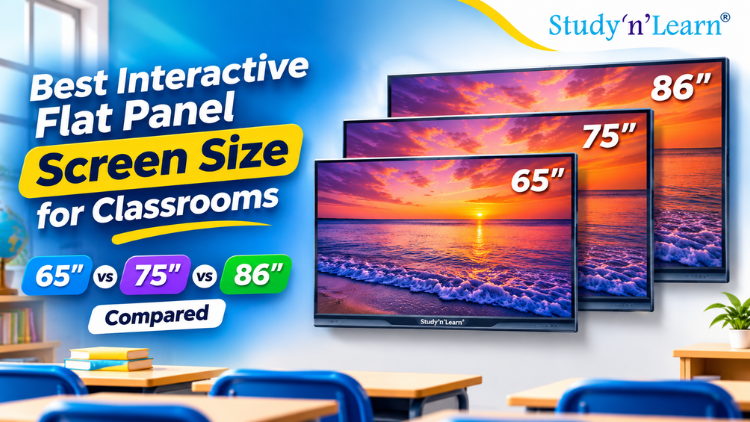
Best Interactive Flat Panel Screen Size for Classrooms: 65-inch vs 75-inch vs 86-inch Smart Board
Interactive Flat Panels
November,02 2026
Mohammad Hamzah
Why Does Interactive Flat Panel Screen Size Matter in Classrooms?

65-Inch vs 75-Inch vs 86-Inch Interactive Flat Panel: Key Differences
| Screen Size | Approx. Width x Height |
| 65-Inch | 56.7 x 31.9 Inches |
| 75-Inch | 65.4 x 36.8 Inches |
| 86-Inch | 75 x 42.2 Inches |
65-Inch Interactive Flat Panel

75-Inch Interactive Flat Panel

86-Inch Interactive Flat Panel

How to Choose the Right Screen Size for Your Classroom

- Classroom dimensions: Measure room depth, width, and clear teaching-wall area.
- Student strength: Count seats in use and note how many rows extend away from the display.
- Seating arrangement: A wide, shallow room differs from a narrow, deep one. Check side-angle visibility.
- Viewing distance: Test normal text, handwriting, equations, and diagrams from the farthest seat.
- Wall placement and installation: Account for board height, electrical points, windows, doors, brackets, and safe cable routing.
- Budget and future needs: Compare full installed cost and expected use over several academic years, not only panel price.
Which Interactive Flat Panel Size Is Best for Different Classroom Types?

Introducing Studynlearn Interactive Flat Panels

Studynlearn Interactive Flat Panels are among the best options for Indian schools looking for a cost-effective yet high-performance digital teaching solution. These panels are designed to enhance classroom learning with integrated K-12 digital content and advanced AI features.
They offer a 4K UHD display for crystal-clear visuals, supporting interactive and engaging lessons. With multi-touch functionality, multiple students can interact simultaneously, promoting collaboration and active learning. The panels come preloaded with educational content, making them ideal for various subjects.
Additionally, they include a 3-year on-site warranty, ensuring long-term peace of mind for schools. The energy-efficient design further helps reduce electricity costs, making them a smart investment for schools.
Key Features of Studynlearn Interactive Flat Panels:
- 4K UHD Display: Offers superior clarity for immersive learning.
- Google EDLA: Google EDLA Certified Interactive Flat Panels.
- SNL Board: In-built SNL board with numerous Interactive and AI tools for interactive learning and teaching. Made In-house with a team of 155 members.
- Operating System: Latest Android 16 with an octa-core processor
- Multi-Touch Support: Allows multiple students to interact simultaneously.
- Preloaded Educational Content: Ready-to-use, curriculum-aligned content.
- Camera and Mic: In-built camera and mic for video conferencing and online classes
- 3-Year On-Site Warranty: Ensures long-term reliability.
- Energy-Efficient Design: Helps reduce electricity costs.
Studynlearn SNL Board

The Studynlearn Interactive Flat Panel comes with an integrated SNL Board, a powerful education-focused platform developed by Studynlearn’s dedicated in-house team of 155+ professionals to make classroom teaching more efficient, engaging, and personalized.
Designed to support the Indian curriculum, the SNL Board provides complete K–12 content, AI courses, 3D models, interactive teaching tools, and rich teacher resources that enhance the learning experience.
Teachers can instantly create lesson plans, quickly search topics, generate question papers for classes 1 to 12, and download them in document or PDF format, significantly reducing their workload.
Students benefit from virtual science experiments, real-life educational videos, and practical examples related to their subjects, making complex concepts easier to understand and learning more interactive and effective.
Read More: Digital Board For Classroom: Before Buying A Smart Board, Ask These 5 Questions
Key Features of Studynlearn SNL Board:
- Curriculum-Focused: Provides step-by-step solutions aligned with the Indian curriculum.
- Multilingual Support: Available in English, Hindi, and various regional languages.
- Fast Content Generation: Creates chapter-wise notes within three days.
- Smart Write: Write content in multiple languages, use text recognition to convert handwritten text into clear and readable digital text, and transform standard text-based equations into properly formatted mathematical formulas.
- K–12 Content: Integrated with comprehensive K–12 educational content.
- Interactives: Practice virtual experiments in Mathematics, Physics, Chemistry, and Biology.
- 3D Models: 3D models for Mathematics, Physics, Chemistry, Biology, and Social Science.
- AI Course: 80+ AI tools, step-by-step learning along with illustrative books.
- Instant Lesson Planning: Enables quick topic searches and question paper generation.
- Vast Resource Library: Offers access to over 6,50,000 questions.
- Custom Content: Allows users to upload PDFs and create personalized study materials.
Conclusion: Which Screen Size Should Your School Choose?
Frequently Asked Questions (FAQs)
The best screen size depends on classroom dimensions, seating arrangements, student strength and viewing distance. A 65-inch panel may work well in a smaller classroom, while a 75-inch panel can be suitable for medium-sized teaching spaces. An 86-inch panel may be more appropriate for larger classrooms where students sit farther away from the display. However, these are general considerations rather than fixed rules. Schools should assess the actual room layout, wall position and visibility from the last row before selecting an interactive flat panel.
The main difference is the screen's diagonal measurement and the resulting display area. An 86-inch panel offers a substantially larger viewing area than a 65-inch panel, while a 75-inch panel sits between the two. A larger screen can make diagrams, presentations, videos and educational content easier to view from farther seating positions. However, screen size alone does not determine display quality. Resolution, brightness, viewing angles, installation height and classroom lighting should also be considered when comparing different panels.
A 65-inch interactive flat panel can be a practical option for smaller classrooms, activity rooms, laboratories and teaching spaces with limited wall area. It provides an interactive display for presentations, digital lessons, annotations and multimedia teaching. However, schools should consider how far students will sit from the panel. If the classroom has multiple seating rows or a wider layout, smaller text and diagrams may become difficult to view from the back. Evaluating the room before installation helps determine whether this screen size meets the institution's teaching requirements.
A 75-inch smart board can be a suitable choice for classrooms that require a balance between display size and available installation space. It offers a larger viewing area than a 65-inch panel, making educational diagrams, presentations, videos and written content easier to display. It can support interactive lessons, teacher annotations and multimedia-based teaching. However, its suitability depends on classroom dimensions, student seating arrangements and viewing distance. Schools should also evaluate display resolution, touch responsiveness, connectivity and software compatibility before making a purchasing decision.
An 86-inch digital board may be worth considering when a classroom has a larger seating area, multiple student rows or greater viewing distances. Its larger display area can help make educational content more visible to students sitting farther from the screen. It may also be useful in training rooms, lecture halls and collaborative learning spaces. However, schools should verify that the available wall space, installation height and room layout can accommodate the display comfortably. A larger panel should be selected based on actual classroom requirements rather than screen size alone.
No. A larger interactive flat panel does not automatically guarantee better teaching outcomes. Effective classroom technology depends on several factors, including content quality, teacher familiarity, display clarity, interactive features and the way the technology is incorporated into lessons. A screen that is too small may affect visibility, while an unnecessarily large screen may not be suitable for a compact classroom. Schools should choose a display that matches their teaching environment and student requirements. Proper teacher training and meaningful use of interactive educational content are equally important for effective digital learning.
Classroom dimensions influence how comfortably students can view and interact with a digital display. A narrow classroom with closely arranged seating may not require the same screen size as a wide classroom with several rows of students. Schools should consider the distance between the display and the farthest student, available wall space, ceiling height and seating arrangement. The panel's installation position is also important because an excessively high or low display can affect visibility. Measuring the classroom and assessing the viewing positions before purchasing helps institutions make a more informed decision.
Screen size is only one part of an interactive flat panel purchase. Schools should also examine display resolution, brightness, viewing angles, touch technology, operating system, RAM, internal storage, connectivity options and built-in audio. Software compatibility and access to educational applications are equally important for everyday teaching. Institutions should also evaluate installation support, warranty coverage, after-sales service and product reliability. Comparing these specifications alongside screen dimensions helps schools identify a solution that meets their classroom requirements and provides practical value over its expected usage period.
An 86-inch interactive flat panel can physically fit in some smaller classrooms, but physical installation does not necessarily mean it is the most suitable choice. Schools should evaluate the available wall space, viewing distance, seating arrangement and screen installation height. A very large display in a compact room may not provide the most comfortable viewing experience, particularly for students sitting close to the screen. Before purchasing, institutions should check the panel's actual width and height, not just its diagonal measurement, and assess whether the classroom layout supports comfortable viewing.
Schools can choose the right digital board by beginning with a practical assessment of their teaching environment. They should measure classroom dimensions, estimate student strength, examine seating arrangements and identify the farthest viewing position. Next, they should compare available screen sizes, display specifications, interactive features, software capabilities and connectivity options. Installation requirements, warranty coverage and after-sales support should also be considered. Consulting an experienced educational technology provider can help schools evaluate different options and select a display that suits their classroom infrastructure, teaching methods and long-term technology requirements.
